Muscle growth is one of the most discussed topics in fitness, yet it remains widely misunderstood. Walk into any gym and you’ll hear different theories—some believe muscle is built only by lifting heavy weights, others focus entirely on supplements, while many assume results come quickly if you just “train harder.” The reality is more structured, and far more interesting, than most people expect.
Once you understand how the body actually builds muscle, training stops feeling like guesswork. Every workout, every meal, and every rest day begins to make more sense.
🧬 The Real Process Behind Muscle Growth
Muscle growth, known in physiology as hypertrophy, is the process where muscle fibers adapt to stress by becoming thicker and stronger.
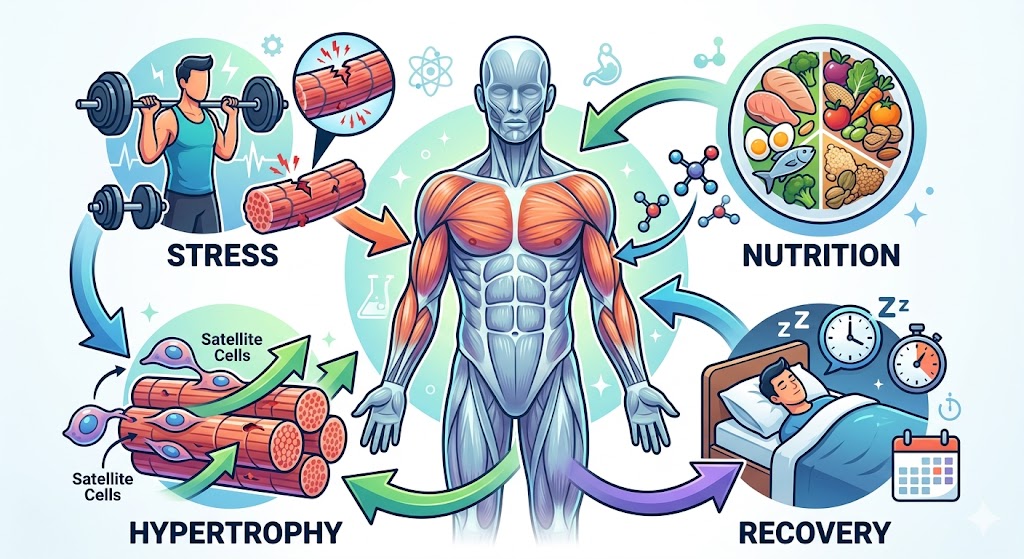
When you perform resistance training—whether it’s lifting weights, bodyweight exercises, or machines—your muscles are exposed to controlled stress. On a microscopic level, this creates tiny disruptions in muscle fibers. These disruptions are not harmful in the long term; instead, they act as signals. The body interprets them as a reason to adapt.
During recovery, the body repairs these fibers. But it does more than simply “fix” them. It rebuilds them slightly larger and more resilient than before, preparing them to handle similar stress more efficiently in the future.
What surprises many beginners is that this process does not happen during the workout itself. Training is only the trigger. The actual growth occurs afterward, when the body is at rest.
🏋️ The Three Mechanisms That Drive Muscle Growth
Scientific research identifies three primary factors that influence hypertrophy. They don’t work in isolation—they interact with each other.
1. Mechanical Tension
Mechanical tension is the force placed on muscles when they contract under load. This is the foundation of muscle growth.
When you lift weights with control and proper resistance, your muscle fibers are forced to generate force under stress. The body responds by strengthening those fibers over time.
This is also where progression matters. If the weight never increases or the challenge never changes, the body has no reason to adapt further. Growth slows down or stops completely.
2. Muscle Damage
Every intense workout creates a small amount of structural stress within muscle tissue. This is often referred to as micro-damage.
Despite the term sounding negative, it is a natural part of adaptation. After exercise, the body activates repair systems that rebuild damaged fibers stronger than before.
However, there is a balance to maintain. Too much damage—often caused by excessive volume, poor form, or lack of recovery—can delay progress and increase the risk of injury.
3. Metabolic Stress
Metabolic stress occurs when muscles are pushed close to fatigue, especially during higher-repetition sets or shorter rest periods. It is often associated with the “burning” sensation during exercise.
This type of stress contributes to muscle growth through cellular responses such as increased blood flow, fluid accumulation in muscle cells, and hormonal signaling. While not the primary driver of growth, it plays a supportive role when combined with proper training intensity.
🧠 Why Growth Actually Happens Outside the Gym
A common misconception is that muscles grow during workouts. In reality, training only provides the stimulus.
The rebuilding process begins after training, during recovery periods when the body has the resources and time to repair muscle tissue. This is why rest is not optional—it is part of the training process itself.
Sleep plays a particularly important role. During deep sleep stages, the body regulates hormones involved in recovery and tissue repair. Inconsistent or insufficient sleep can significantly reduce progress, even if training is excellent.
Recovery also depends on overall lifestyle factors such as stress levels, hydration, and daily activity.
🍗 Nutrition: Supporting the Repair Process
Training creates the demand for muscle growth, but nutrition provides the materials needed to complete it.
Protein is especially important because it supplies amino acids, which are essential building blocks for muscle tissue repair. Without adequate protein intake, recovery becomes slower and less efficient.
Carbohydrates support training performance and help replenish energy stores, while dietary fats play a role in hormone regulation. Together, these nutrients ensure the body has the resources it needs to adapt.
Rather than relying on extreme diets or unnecessary supplements, consistency in balanced nutrition is what supports long-term progress.
📈 Progressive Overload: The Principle of Adaptation
Muscles grow in response to increasing demands. If training remains the same over long periods, the body adapts and progress plateaus.
This is why progressive overload is essential. It simply means gradually increasing training difficulty over time. This can be achieved in different ways, not just by lifting heavier weights.
Adjustments such as improving form, increasing repetitions, adding sets, or reducing rest periods all contribute to progression.
The key idea is continuous challenge—without it, adaptation slows.
😴 The Often Ignored Role of Rest and Sleep
Rest days are not a sign of inactivity; they are part of the growth process. Muscles need time to recover fully before they are trained again.
Sleep is equally important. It is during sleep that the body performs much of its repair work, including hormone regulation and tissue rebuilding. Most individuals benefit from consistent, high-quality sleep of around 7 to 9 hours per night.
When sleep is neglected, performance drops, recovery slows, and long-term progress becomes harder to sustain.
⚠️ Common Barriers to Muscle Growth
Many people struggle not because of genetics or lack of effort, but due to a few avoidable mistakes:
Training too frequently without recovery
Eating too little protein or total calories
Repeating the same workouts without progression
Poor exercise technique
Inconsistent training habits
Correcting even one or two of these issues can noticeably improve results over time.
🏁 Final Perspective
Muscle growth is not a mystery or a shortcut-based process. It is a gradual biological adaptation driven by stress, recovery, and consistency.
Training provides the signal, nutrition provides the building materials, and rest allows the transformation to happen. When all three work together, progress becomes steady and sustainable.
In the long run, success in bodybuilding is less about extreme effort and more about understanding the system—and applying it consistently over time.